.png)



“BUILD SMARTER – CHOOSE THE HSE FLOOR”
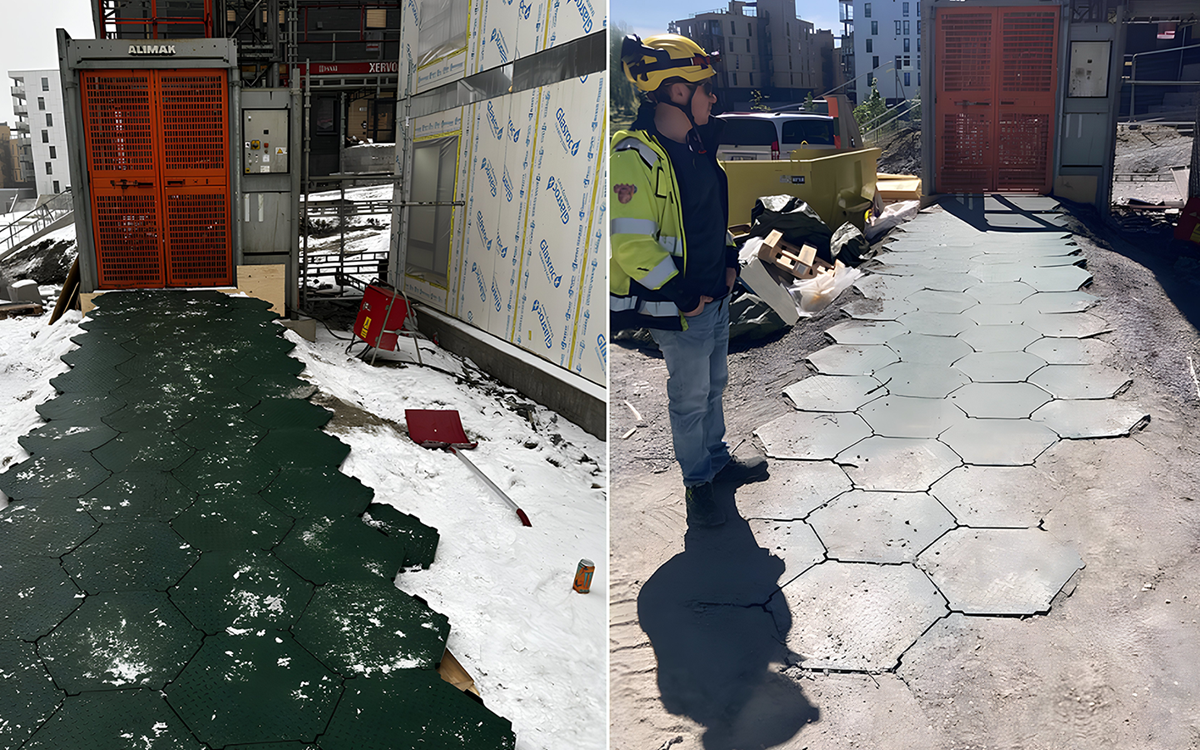
HSE Floor – the smart protective underlay that elevates the entire construction site
Today, temporary structures, such as plywood sheets combined with expanded metal, are used to create walkways, platforms, and surfaces in front of elevators, entrances, and on rooftops. While this has worked, it comes with several challenges:
Safety: Plywood becomes very slippery in rain, snow, and ice. Expanded metal is laid on top to reduce the risk, but this makes the solution more time-consuming and costly.
Durability: Plywood handles moisture and cold poorly. The sheets swell, break, and lead to extra costs, waste, and increased accident risk.
Time Consumption: Large sheets (120 × 240 cm) adapt poorly to uneven surfaces and create trip hazards. Regular inspections and repairs are necessary. Installation and removal are time-intensive.
Costs and Waste: When the structures are no longer needed, they are often discarded as residual waste. Expanded metal is rarely removed because it is perceived as time-consuming. The result is unnecessary material costs, high waste volumes, and poor environmental performance (kg/BTA).
Unpredictability: Construction sites are affected by clay, snow, water, and uneven surfaces. Current solutions are heavy, hard to adapt, and inflexible.
DURING WINTER
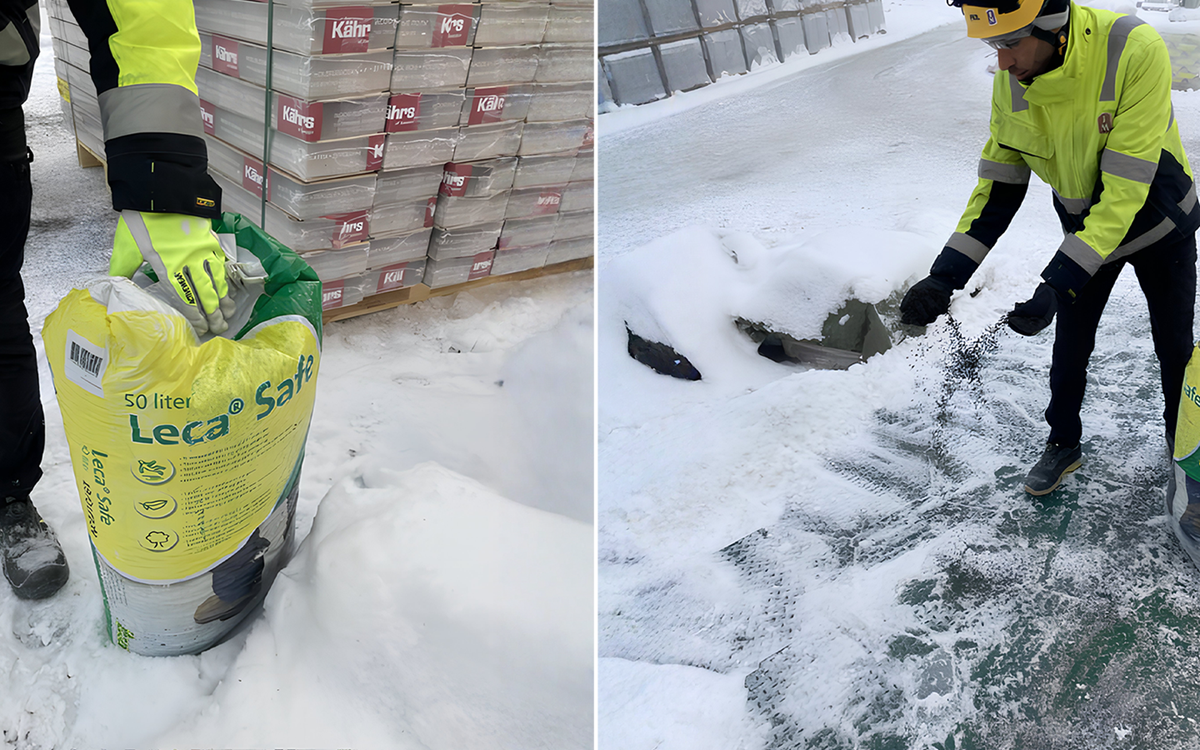
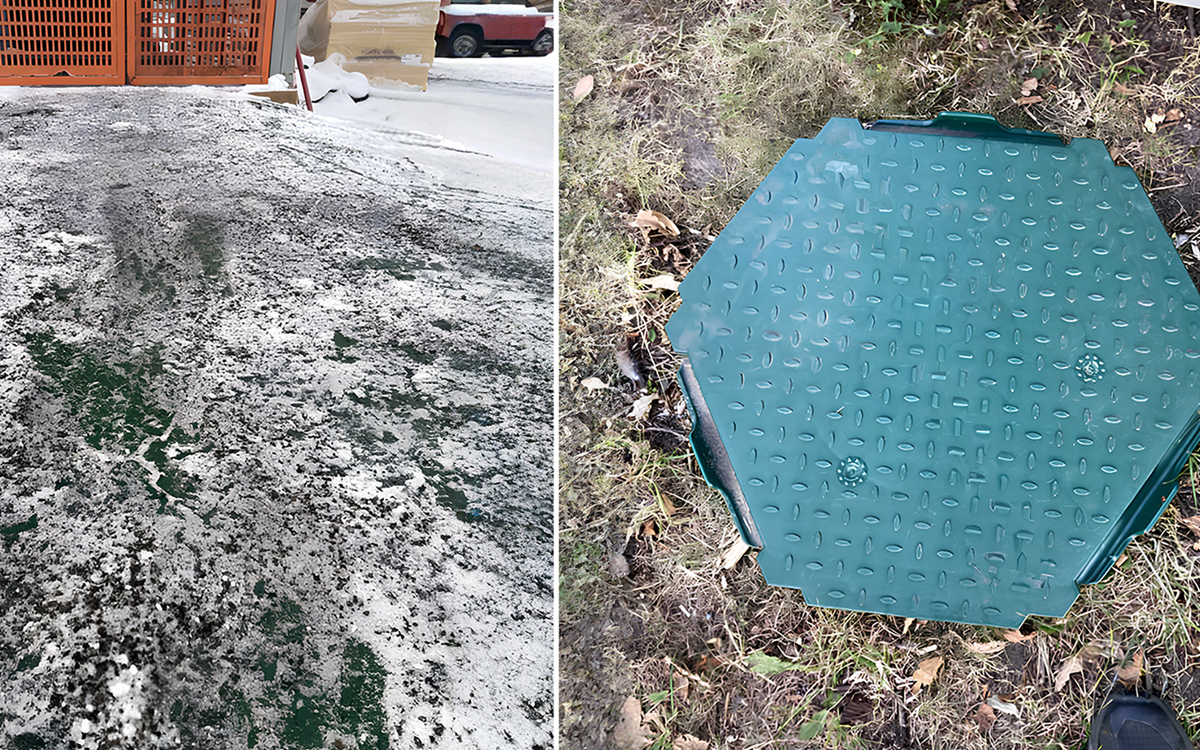
During winter, standard snow removal applies – snow and ice are easily cleared. Ice releases easily and does not stick to the floor panels, unlike plywood and expanded metal, where snow and ice merge to create a slippery and hard-to-manage surface. With the HSE Floor, you get a surface that remains safe, practical, and easy to maintain – even in harsh winter conditions.
SLIP-RESISTANT
Several tests have been conducted with different anti-slip materials – sand, gravel, crushed stone, and salt. The material that showed the clearest effect was LECA pellets. They provide significantly better grip, are easy to handle, and perform optimally on the HSE Floor under challenging winter conditions.
A slip-safety study has also been filmed, allowing real-time observation of how conditions change under various weather and wind scenarios. This provides a clear and practical visualization of how the HSE Floor performs in real-life situations.

HSE and Safety:
- Slip-resistant, even in snow, rain, and ice
- Safe, even surfaces for employees, suppliers, customers, and heavy equipment
- Reduces the risk of falls and trip hazards
- A unified standard across all construction sites makes HSE monitoring easier

Efficiency and Resource Utilization:
- Quick and easy installation and removal
- Modular panels can be adapted and cut as needed
- Less time-consuming than plywood and expanded metal
- Follow-up and relocation are significantly easier than handling old, swollen plywood sheets

Durability and Environment:
- Made from recycled plastic
- Can be recycled again if damaged
- Reduces the use of disposable materials (wood and metal)
- Significantly less waste, contributing to lower kg/BTA

Economy:
- In the long term, renting the HSE Floor is cheaper than the current disposable solutions
- Less residual waste reduces waste management costs
- Faster installation and removal save labor time
- Longer lifespan → better overall economy

Professional Impression:
- Modern and tidy protective flooring
- Creates a professional appearance on the construction site
- Enhances the experience for customers, suppliers, and employees

Sustainability Profile:
- Supports the company’s sustainability strategy
- Clear contribution to the circular economy
- Based on the PPP principle – People, Planet, Profit
- When all three aspects are addressed, the solution is sustainable over time

ESTIMATED COST AND CO₂ SAVINGS
Background
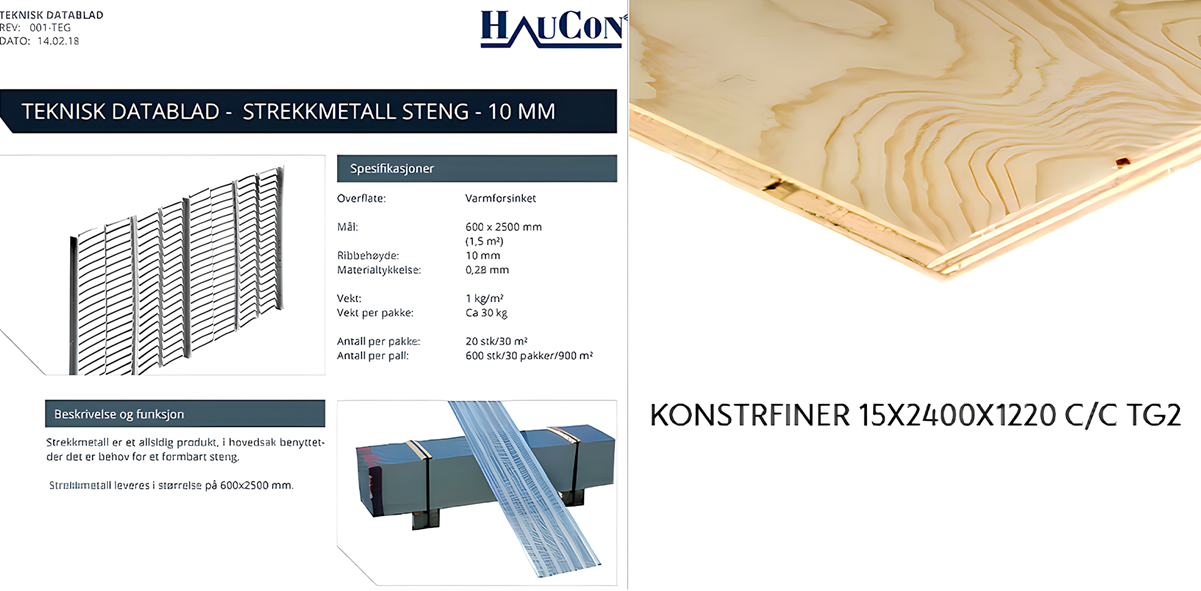
The calculation presents an updated overview of the cost and climate impact of switching from the current temporary ramps (plywood + expanded metal) to a reusable HSE Floor, owned, stored, and managed by the residential developer. The calculations are based on technical datasheets for HauCon expanded metal and typical weights for Moelven construction plywood.
Assumptions
Activity
- 4 projects per year
- 5 years → total of 20 projects
- Requirement per project: 200 m² of HSE Floor
Disposable Materials
Current Solution
- 200 m² plywood + expanded metal per project
- Cost per project: NOK 79,708
- 20 projects → total: NOK 1,594,160
New Solution
HSE Floor (Reusable)
- One-time purchase: 500 m²
- Estimated price: NOK 350/m²
- Investment: 500 m² × NOK 350
- = NOK 175,000
- Maintenance/replacement over 5 years:
- = NOK 25,000
- Total estimated cost over 5 years:
- = NOK 200,000
Economic Savings
NOK 1,594,160 – NOK 200,000 = NOK 1,394,160 saved over a 5-year period

Material Use (Adjusted Weights)
Expanded Metal (HauCon Steng 10 mm):
- 1 kg/m²
- 200 m² × 1 kg/m² = 200 kg (0.2 tons) per project
- 20 projects → total 4 tons
Plywood 15 mm, approx. 21.9 kg/sheet:
- Sheet size: 2400 × 1220 mm = 2.928 m² per sheet
- Weight per m²: 21.9 kg ÷ 2.928 m² ≈ 7.48 kg/m²
- Per project: 200 m² × 7.48 kg/m² ≈ 1.5 tons
- 20 projects → total: 29.9 tons
Reduction in Disposable Material: approximately 33.9 tons
CO₂e Calculation (Materials)
Factors:
- Steel: 2.0 tons CO₂e per ton
- Wood: 0.4 tons CO₂e per ton
Emissions:
- Expanded metal: 4 tons × 2.0 = 8 tons CO₂e
- Plywood: 29.9 tons × 0.4 ≈ 12 tons CO₂e
Total material-related reduction: approximately 20 tons CO₂
Transport and Waste
Assumptions:
- 40 waste pickups over 5 years
- Total waste: 33.9 tons
- Cost per trip: NOK 1,095
- Processing cost: NOK 650 per ton
Average load: 0.85 tons per trip
- Cost per trip: NOK 1,095 + (NOK 650 × 0.85) ≈ NOK 1,646
- Total cost: NOK 1,646 × 40 ≈ NOK 65,900
CO₂ from Waste Transport:
- 0.08 tons CO₂ per project × 20 ≈ 1.6 tons CO₂
Reduction with HSE Floor:
Approximately NOK 65,000–70,000 saved in waste and transport costs
Overall Impact (5 years / 4 projects per year)
Cost Savings
Switching from the current solution to the HMS Floor results in significant project cost reductions.
- Current solution: NOK 1,594,160
- HSE Floor: NOK 200,000
Total savings: NOK 1,394,160
Environmental Benefits
The HSE Floor reduces material use and significantly lowers emissions.
- 33.9 tons of disposable materials avoided
- 20 tons CO₂ saved through reduced material use
- 1.6 tons CO₂ saved from transport
Total: approximately 21.6 tons CO₂ reduction
Operations & HSE Benefits:
The solution provides safer and more predictable projects
- Standardized and safe work surface
- Significantly less assembly and dismantling – lower risk
Simplified logistics for the residential developer
Reduced Transport and Waste:
- Fewer deliveries and less waste lead to lower costs and simpler operations
- 40 unnecessary pickups eliminated
NOK 65,900 saved in transport and processing costs
Final Assessment and Conclusion
By investing in 500 m² of HSE Floor, the residential developer makes a strategic choice that strengthens both the bottom line and the company’s sustainability – right from day one.
The results are powerful:
- NOK 1.39 million saved over just 5 years
- 33.9 tons less disposable material – a significant reduction in resource use
- 21.6 tons of CO₂ cut – a solid climate contribution
- Drastically reduced transport and waste handling
- Improved HSE, safer workplaces, and more efficient project execution
In short, the HSE Protection Floor tiles deliver documented savings, strong environmental benefits, and a more professional construction process. This is not just a smart choice – it is a solution that should become the standard!
Contact & Information

IP-Group
Geir Vidar Persen
Sales Director
Mobile: +47 960 49 556